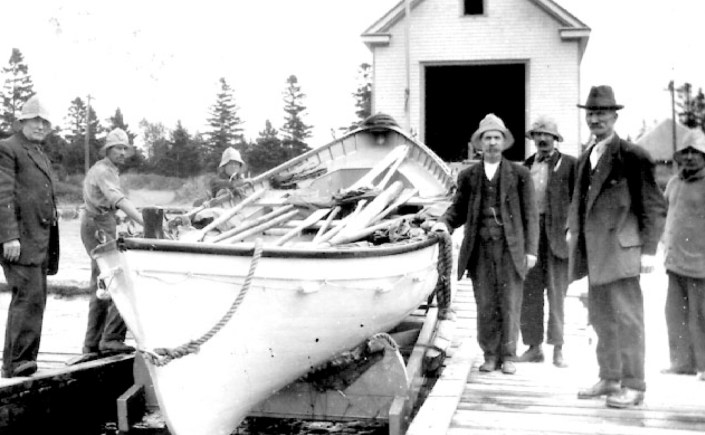
parable of the lifesaving station

I don’t remember where or when I first heard this parable, but it always comes to mind on days like today. Some days, I feel like the church I serve is making great strides toward becoming more effective in carrying out our unique mission in reaching this world for Christ. Then there are days (like today) when I hear about people who would rather continue the status quo, or back track to what is comfortable and familiar. Frankly, it breaks my heart. It breaks my heart for the world around us that is paying the price for the church’s indifference–addictions, crumbling families, hopelessness… and it breaks my heart for the Christians who equate their faithful attendance to Sunday School, morning worship, evening worship and midweek prayer meeting, but in reality, are having little if any impact for the Kingdom of God. They have bought into the lie of the evil one and unless they wake up, they will miss their opportunity to make a difference in this life and have little to show for it in eternity.

The Parable of the Lifesaving Station was originally written by an Episcopal priest named Theodore Wedel in 1953. Let his words remind you of the purpose churches exist. Then ask yourself, “Which group of people do my actions place me in?” As for me and my family, God helping us, we’ll be the ones fighting for the church’s original mission–even if it means relocating like those in the parable!

A Crude Lifesaving Station by Theodore Wedel

On a dangerous seacoast where shipwrecks often occur there was once a crude lifesaving station. The building was just a hut, and there was only one boat, but the few devoted members kept a constant watch over the sea, and with no thought for themselves went out day and night tirelessly searching for the lost. Many lives were saved by this wonderful little station, so that it became famous. Some of those who were saved, and various others in the surrounding area, wanted to become associated with the station and give of their time and their money and their effort for the support of its work. New boats were bought and new crews were trained. The little lifesaving station grew.

Now some of the members of the lifesaving station became unhappy, in time, however, because the building was so crude and so poorly equipped. They felt that a more comfortable, suitable place should be provided as the first refuge of those saved from the sea. And so they replaced the emergency cots with beds, and they put better furniture in the now enlarged building, so that now the lifesaving station actually became a popular gathering place for its members. They took great care in decorating it beautifully and furnishing it exquisitely, for they found new uses for it in the context of a sort of club. But fewer members were now interested in going to sea on lifesaving missions, and so they hired lifesaving crews to do this work on their behalf, and in their stead. Now, don’t misunderstand, the lifesaving motif still prevailed in the club’s decoration and symbols — there was a liturgical lifeboat (symbolic rather than fully functional) in the room where the club initiations were held, for example — so the changes did not necessarily mean that the original purposes were totally lost.

About this time a large ship was wrecked off the coast, and the hired crews brought in boatloads of cold and wet, half-drowned people. They were dirty people and they were sick people, some of them with black skin, some with yellow skin. The beautiful new club, as you might imagine, was thrown into chaos, so that the property committee immediately had a shower house built outside the club where these recent victims of shipwreck could be cleaned up before coming inside the main clubhouse.

At the very next meeting, there was a split in the club membership. Most of the members wanted to stop the club’s lifesaving activities for being so unpleasant, as well as for being a hindrance to the normal social life of the club. Some members insisted upon lifesaving as their primary purpose, pointing out that, indeed, they were still called a lifesaving station. But these few were finally voted down and told that if they wanted to save the lives of all the various kinds of people who were shipwrecked in those waters, they could begin their own lifesaving station down the coast. And so, they did just that.

Now as the years passed, the new station down the coast came to experience the very same changes that had occurred in the older, initial station. It evolved into a club, and yet another lifesaving station had to be founded to restore the original purpose.

Well, history continued to repeat itself, so that if you visit that seacoast today, you will find a great number of exclusive clubs along that shore. Shipwrecks are frequent in those waters, but most of the people drown!

under-program your church

One of the biggest dangers in many churches today is over-programming or being a “program-driven” church. Now, I’ve never heard a church that actually admitted to being program-driven. “Why yes, we are a program driven church!” Just the opposite! We go to great lengths to try to justify our busy-ness. In truth, nearly every church is over-programmed because there is a gravitational pull toward programs.

Here in Corbin, KY, I have been amazed to see that no matter the denomination, churches all offer the same programming with little if any variation–Sunday School, Sunday morning Worship, Sunday evening worship, and a midweek service. People are amazed when I tell them that this is the first church I’ve served in over 12 years that still does a Sunday night worship service! On top of that we add church dinners, socials, visitation programs…

I actually vowed that I would never take a position at another church that had Sunday night services because the Church is already over-preached and under-practiced. You gotta watch out when you say, “I’ll never ______!” But, the last thing Christians need is to consume another worship experience. We need to start applying some of what we have learned and stop consuming!

For too long, churches have equated attendance at worship services, events and programs with spiritual growth. Well, all we have to do is look around at the Church in North America and see the falsehood in that logic! But, to be fair, just because you follow a Simple Church model and offer fewer services, events or programs, it doesn’t mean your people are growing spiritually, either!

At our church, we are working on simplifying our services, events and programs. However, at the same time, we are attempting to develop a laser-like discipleship process. You see, our programs, events and services are just the means to and end. They should expose people to living their own life on mission in the world everyday. However, people have grown dependent on services, events and programs, and, as a result, the church has become dependent on the services, events and programs. It’s a co-dependent relationship!

The Church must train its people to move beyond relying on the worship services for their spiritual nourishment and equip them to have deep personal times with God on their own. We must move them beyond serving opportunities within the church to seeing the incredible needs in their community and serving their fellow man in the name of Jesus on their own. And, we must move them beyond visitation programs or mission trips to where they see their life as that of a missionary called to reach their neighbors, co-workers and classmates.

The services, events and programs are most important to new believers. But the Church must wean its people off of programs and then serve as spiritual coach and mentor instead of continuing to spoon feed believers.

The following is a reprint from Jared Wilson’s blog from Monday, April 26th on why we shouldn’t over-program our churches:

1. You can do a lot of things in a mediocre (or poor) way, or you can do a few things extremely well. Craig Groeschel has some great things to say about this subject. Also check out Thom Rainer and Eric Geiger’s Simple Church.

2. Over-programming creates an illusion of fruitfulness that may just be busy-ness. A bustling crowd may not be spiritually changed or engaged in mission at all. And as our flesh cries out for works, many times filling our programs with eager, even servant-minded people is a way to appeal to self-righteousness.

3. Over-programming is a detriment to single-mindedness in a community. If we’re all busy engaging our interests in and pursuits of different things, we will have a harder time enjoying the “one accord” prescribed by the New Testament.

4. Over-programming runs the risk of turning a church into a host of extracurricular activities, mirroring the “Type-A family” mode of suburban achievers. The church can become a grocery store or more spiritual YMCA, then, perfect for people who want religious activities on their calendar.

5. Over-programming dilutes actual ministry effectiveness. Because it can overextend leaders, increase administration, tax the time of church members, and sap financial and material resources from churches.

6. Over-programming leads to segmentation among ages, life stages, and affinities, which can create divisions in a church body. Certainly there are legitimate reasons for gathering according to “likenesses,” but many times increasing the number of programs means increasing the ways and frequencies of these separations. Pervasive segmentation is not good for church unity or spiritual growth.

7. Over-programming creates satisfaction in an illusion of success; meanwhile mission suffers. If a church looks like it’s doing lots of things, we tend to think it’s doing great things for God. When really it may just be providing lots of religious goods and services. This is an unacceptable substitute for a community on mission, but it’s one we accept all the time. And the more we are engaged within the four walls of the church, whether those walls are literal or metaphorical, the less we are engaged in being salt and light. Over-programming reduces the access to and opportunities with my neighbors.

8. Over-programming reduces margin in the lives of church members. It’s a fast track to burnout for both volunteers and attendees, and it implicitly stifles sabbath.

9. Over-programming gets a church further away from the New Testament vision of the local church. Here’s a good test, I think: take a look at a typical over-programmed church’s calendar and see how many of the activities resemble things seen in the New Testament.

10. Over-programming is usually the result of un-self-reflective reflex reactions to perceived needs and and an inability to kill sacred cows that are actually already dead. Always ask “Should we?” before you ask “Can we?” Always ask “Will this please God?” before you ask “Will this please our people?” Always ask “Will this meet a need?” before you ask “Will this meet a demand?”