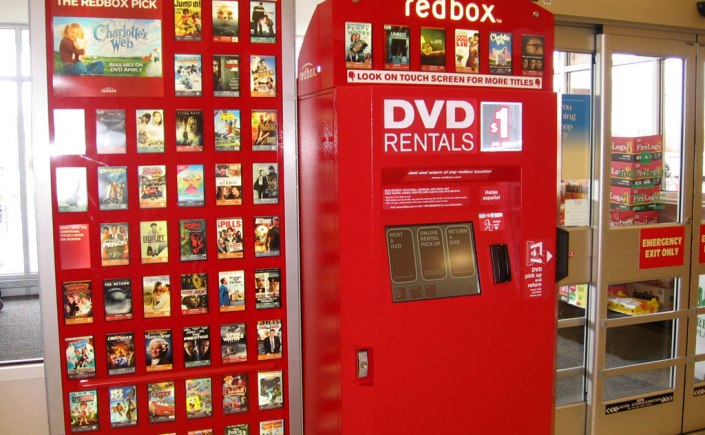
This past Saturday, I wrote about lessons from Blockbuster Video. Today, it occurred to me that the church could take some lessons from Redbox. If you’re not familiar with Redbox, it is an extremely cool concept in video rental. Redbox has managed to survive–and even thrive–in the age of streaming videos. They have managed to cut the overhead by putting an entire video store in a kiosk. And you find them everywhere! You can reserve a movie through a smartphone app and pick it up as you leave the grocery store. And it only costs about $1 for 24 hours!
Now, what can the Church learn from a movie renting kiosk? Here are a few of my thoughts:
- No frills – Redbox keeps the main thing the main thing. Movies. There’s no buying popcorn, soda or candy from the kiosk. What should the church’s main thing be? Some would point to the Great Commission (Mt 28:19-20), and that would be close, but the Great Commission wasn’t given to churches. It was given to individuals. My favorite quote is “if you build the church, you won’t necessarily get disciples; but if you build disciples, you will always get the Church” (Mike Breen, 3DM) In other words, church services and programs don’t make disciples–people do. The Church is the result of discipleship and should be the place where disciples gather to worship, celebrate, get equipped and then scatter to push God’s Kingdom into every nook and cranny of the surrounding culture. See my blog post half-time speech vs. gameday.
- Low overhead – Redbox has low overhead. It doesn’t have to pay for brick and mortar stores and store employees. Sure, someone’s got to stuff all those movies in the kiosk, but compared to Blockbuster, Redbox has got to have pretty low overhead. I’ve been on staff at some churches where the payroll alone was over 60% of the annual budget. Cut the programs back and it probably means you don’t need all those staff members (and if you cut back some of the programs, you might lose some of your dead weight consumers!). And what about those multi, multi-million dollar facilities and massive church campuses? Sure, the church needs a place to gather for worship, but do we really need an education wing to heat and cool for one hour a week? Homes are much better for groups anyway! I have a feeling that in the not so distant future, churches in America are going to be forced to reduce their budgets. In the not-so-distant-future, churches that stand on Biblical convictions could lose their tax-exempt and 501c3 status. If that happens, giving to churches will likely plummet.
- They’re everywhere – It seems like there’s a Redbox kiosk just about everywhere you turn around–grocery stores, fast food establishments, etc. What does it take for a new Redbox location? I’m guessing some sort of agreement, electricity and an internet connection. It is a model that is easily duplicatable. In our current day and age, what does it take to start a new church? Some would say that you’ve got to have a great communicator, a really good worship leader and awesome band, lots of attractive signage, tens of thousands of dollars worth of technology (audio, video, lighting). Oh, and a cool space to meet like a movie theater or fine arts auditorium. That’s a serious chunk of change! It’s no wonder that according to the North American Mission Board of the Southern Baptist Convention, only 68% of church plants survive. I’m sure many of those that fail run out of money. Some probably have leaders who quit or move on to other ministries. Other church plants just end up attracting all the people who are disgruntled at their current church and end up imploding from internal strife. But if discipleship and mission were put back in the hands of ordinary people, new communities of believers (churches) could spring up just about anywhere.
- They’re effective – According to Redbox Profits, 15 DVDs are rented each second! At some point, the movie rental industry might shift entirely to streaming movies and those little red kiosks will probably disappear. In fact, Redbox recently unveiled its own streaming service to compete with Netflix. If our American churches were evaluated for how well they were helping to put discipleship and mission back into the hands of ordinary people, how many would be considered “effective”? Sadly, it would probably only be a few. Too many of our churches are only effective at attracting consumers and perpetuating a co-dependent relationship with the paid professional clergy. In these churches, the people are dependent on the paid clergy for their spiritual food and the paid clergy are dependent on the people for their paychecks. It’s a phenomenon Mike Breens calls “spiritual feudalism.”
Can you think of any more?
 Kevin Haglund